

Why Listeria Keeps Coming Back in Food Processing Facilities
A food processing facility can appear spotless and still harbor Listeria monocytogenes.
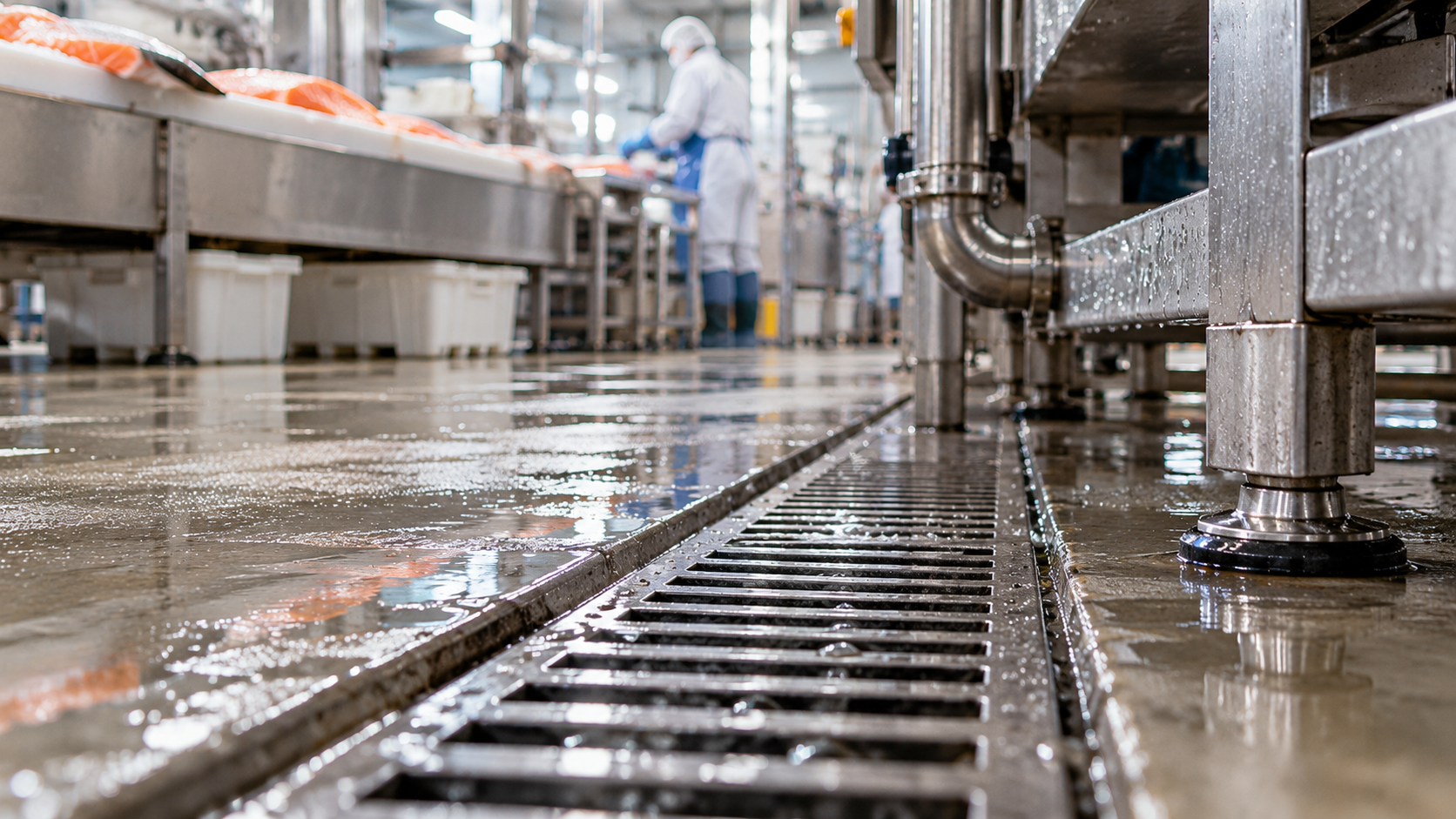
Unlike contamination limited to a particular product, Listeria can establish itself in the processing environment, persisting in drains, equipment seams, floor cracks, and other areas that are difficult to clean.
For seafood processors and ready-to-eat (RTE) food manufacturers, this creates a challenge that routine surface sanitation and finished-product testing alone may not adequately address.
Why Listeria Can Persist in Processing Facilities
Listeria monocytogenes is particularly troublesome because it can survive under refrigerated conditions and persist in damp processing environments.
It can also form biofilms, communities of microorganisms protected by a matrix that makes them more difficult to remove through conventional cleaning and sanitizing procedures.
Once established in an equipment seam, drain, or other harborage site, contamination may repeatedly spread to nearby surfaces.
The FDA recognizes environmental contamination as an important pathway through which pathogens can reach finished foods. Its guidance emphasizes sanitary equipment design, environmental monitoring, preventive controls, and corrective action.
Finished-product testing remains important, but it cannot guarantee that contamination is absent throughout a facility. Environmental monitoring helps identify potential contamination sources before they affect finished products.
Learn more about FDA environmental sampling and monitoring.
Can Ozone Help Address Listeria Biofilms?
Ozone has attracted interest as an additional sanitation technology because of its strong antimicrobial properties and its ability to decompose into oxygen rather than leave a persistent ozone residual.
It can be applied through appropriately designed ozonated-water systems or controlled gaseous applications, depending on the environment and treatment objectives.
A systematic review published in Food Control in October 2026 examined ozone's effectiveness against Listeria monocytogenes biofilms on food-processing surfaces.
The researchers found evidence that ozone can reduce Listeria biofilms, sometimes substantially. However, effectiveness varied according to ozone concentration, exposure time, surface material, biofilm structure, and the presence of organic matter.
The review also emphasized the need for more standardized treatment protocols and validation under real industrial conditions.
Read the 2026 systematic review in Food Control.
These findings suggest that ozone may be a valuable addition to sanitation programs, but it should not be considered a substitute for thorough cleaning, environmental monitoring, or validated preventive controls.
Designing Sanitation Around the Entire Environment
Effective Listeria prevention requires looking beyond the surfaces that are easiest to see and clean.
Equipment design, drainage, moisture management, sanitation procedures, and environmental monitoring all contribute to controlling contamination.
For facilities evaluating ozone treatment, the important questions are where it can be applied effectively, how performance will be verified, and how it fits within existing sanitation procedures.
Ozone International works with seafood processors and other food manufacturers to evaluate ozone treatment opportunities within their operations.
Whether the objective is improved process-water treatment or additional microbial control, the focus should be on developing a practical, measurable sanitation strategy.
Is your sanitation program addressing only the surfaces you can see, or the contamination risks you can't?
Our engineers work directly with food processors, water utilities, and industrial operators. Bring us the problem — we'll help you identify the right ozone approach.