

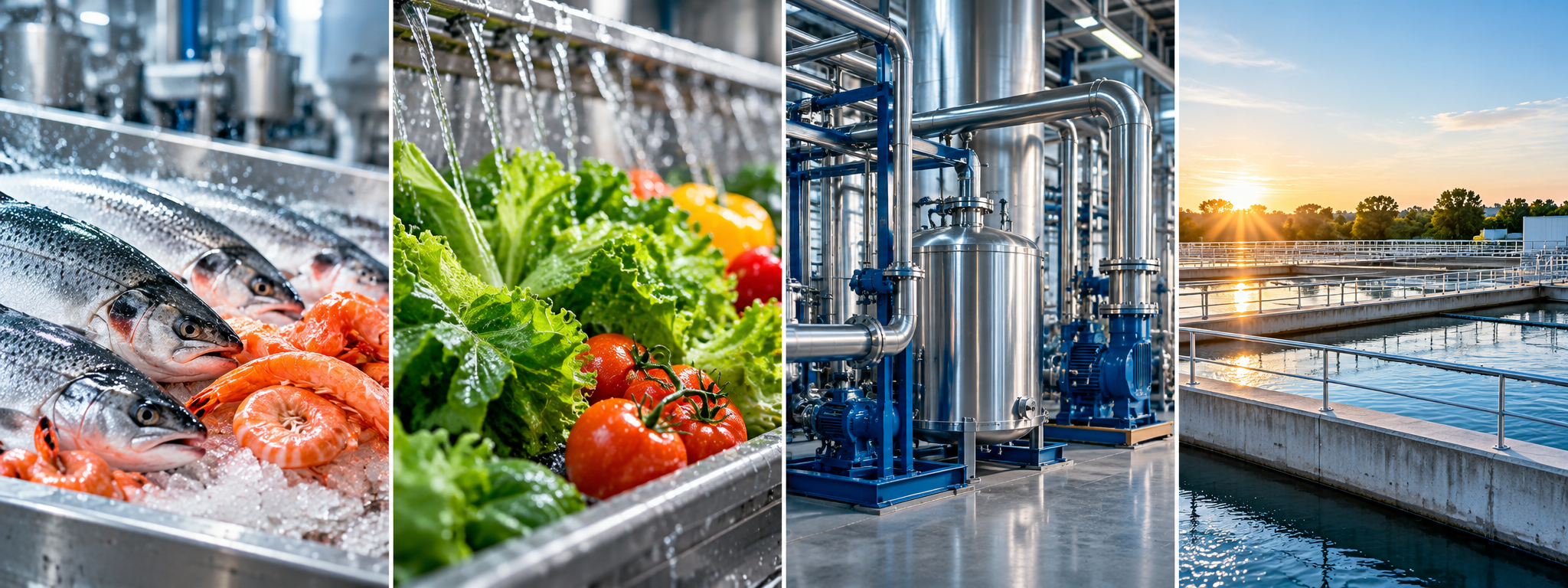
One Technology, Four Industries: How Ozone Water Treatment Solves Different Challenges
From seafood processing and fresh produce to industrial facilities and municipal water systems, ozone technology is used to address a wide range of water quality and sanitation challenges.
While these industries have different operational requirements, they share a common need: effective treatment that supports safety, quality, and reliable performance.
What makes ozone particularly versatile is its ability to act as a powerful oxidant and antimicrobial agent across multiple applications. But the benefits depend on how and where the technology is used.
The value of ozone isn't simply that it works across different industries. It's that the technology can be adapted to address the specific water quality challenges each industry faces.
Seafood Processing: Improving Microbial Control
For seafood processors, controlling microbial contamination is essential to protecting product quality and managing spoilage.
Ozonated water can be incorporated into certain washing and processing applications to help reduce microbial loads. Research published in Comprehensive Reviews in Food Science and Food Safety highlights studies in which ozone treatments reduced microbial growth in salmon and shrimp, with potential benefits for product quality and shelf life.
Treatment effectiveness depends on factors such as ozone concentration, contact time, and the seafood being processed.
Explore the seafood processing research.
Fresh Produce: Reducing Contamination and Protecting Freshness
Fresh produce presents a different challenge. Because many fruits and vegetables are consumed raw, controlling contamination during washing and handling is particularly important.
Ozonated water has been studied as an antimicrobial treatment for produce washing, including applications involving E. coli, Salmonella, and Listeria.
A 2024 meta-analysis of 25 studies found that ozone treatment methods and processing conditions significantly influenced microbial reduction. The findings reinforce an important point: successful treatment depends on selecting and maintaining the appropriate operating conditions.
Read the produce washing study.
Industrial Facilities: Supporting Process Water Quality
In industrial environments, ozone is used for applications ranging from microbial control to the oxidation of certain contaminants in process water.
Because ozone is generated on-site from oxygen or air, it can reduce dependence on some delivered treatment chemicals. This may offer operational advantages for facilities seeking to simplify chemical handling and improve treatment consistency.
Effective implementation requires careful consideration of water chemistry, treatment objectives, equipment maintenance, and operating costs.
Municipal Water Treatment: Addressing Water Quality Requirements
Municipal water utilities use ozone for applications including disinfection, oxidation, and the control of certain taste- and odor-causing compounds.
EPA guidance identifies ozonation as an established treatment approach, while also emphasizing the importance of selecting treatment methods appropriate to specific water quality conditions.
For municipalities, ozone is generally one component of a broader treatment process, often working alongside filtration and other disinfection methods.
Explore EPA guidance on drinking water treatment.
Different Applications, Shared Priorities
Although the applications vary, these four industries share several priorities: consistent treatment performance, manageable operating costs, reliable equipment, and the ability to monitor results.
The value of ozone isn't simply that it works across different industries. It's that the technology can be adapted to address the specific water quality challenges each industry faces.
At Ozone International, we help organizations evaluate where ozone treatment can improve existing processes, whether the goal is microbial control, water quality, operational efficiency, or greater system reliability.
From system design and integration to monitoring and ongoing service, our focus is on developing solutions that fit each operation's needs.
Our engineers work directly with food processors, water utilities, and industrial operators. Bring us the problem — we'll help you identify the right ozone approach.