
A regional problem with operational consequence
"Norovirus presents a particular challenge for shellfish operations because contamination can move through more than one part of the processing environment"
Moving from reactive response to continuous pathogen reduction
Ozone offers a different approach.
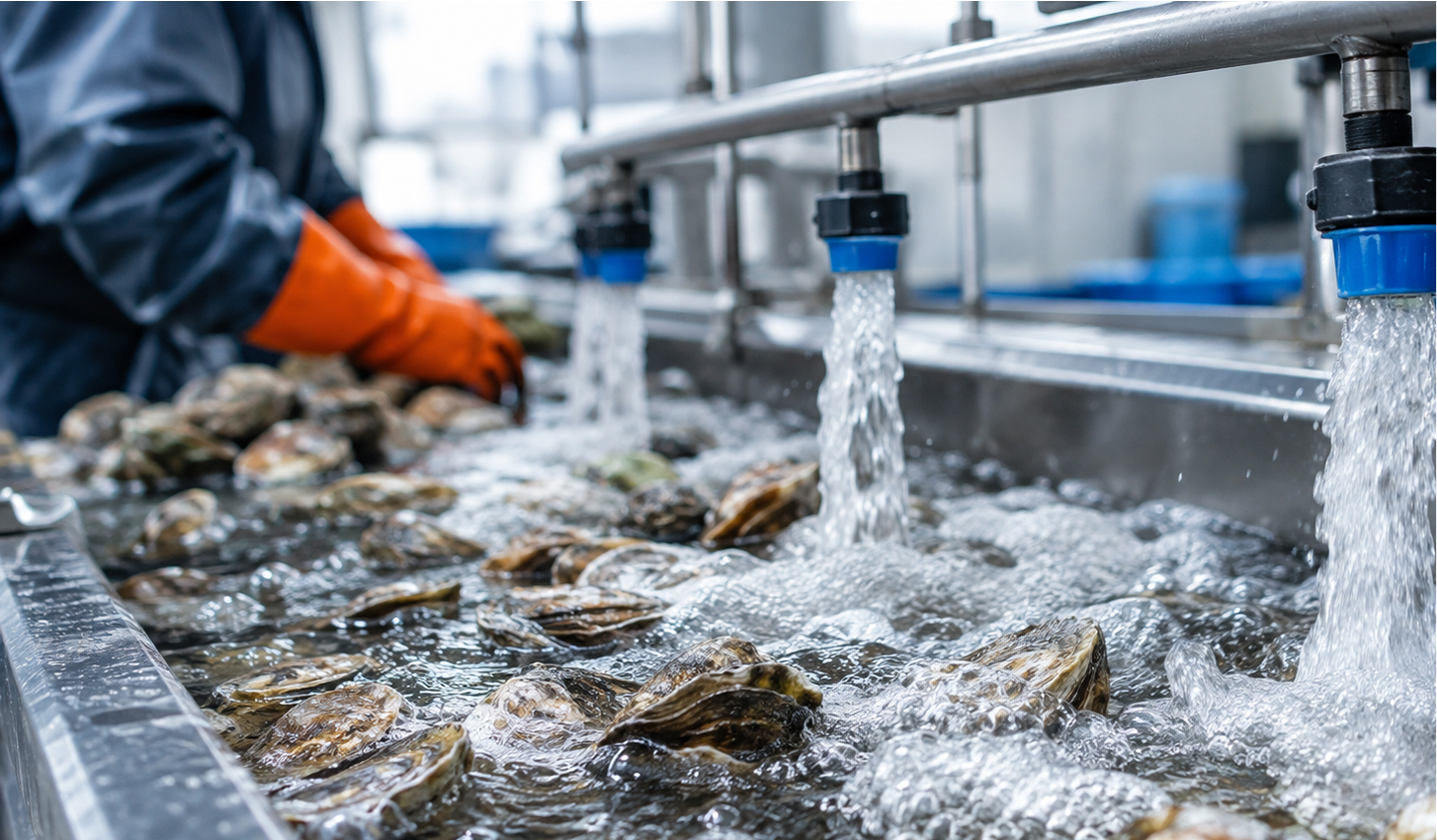
Rather than relying solely on periodic sanitation cycles or responding after a problem occurs, ozone can be integrated into existing processing systems to provide continuous pathogen reduction in wash water and flume systems. It can also be applied to appropriate nonporous food-contact surfaces as part of a broader sanitation program. The goal isn't to replace every existing sanitation procedure. It's to add another layer of control where continuous treatment can help reduce pathogen risk.For processors, that distinction matters. A sanitation program isn't simply about what happens when contamination is discovered. It's about establishing consistent controls that can be monitored, documented and incorporated into normal operations.
Why ozone?
Ozone has been used for decades in water treatment and food-processing applications, including environments where control of microbial contamination is critical. Its primary advantage for shellfish processors is that it can provide antimicrobial treatment without leaving the chemical residues associated with many traditional sanitizing agents.When ozone decomposes, it ultimately reverts to oxygen, making it particularly useful in applications where residual chemicals and potential flavor impacts are concerns. For shellfish operations, that can mean an additional sanitation tool without fundamentally changing the characteristics of the product
Ozone can be incorporated into systems such as:
- Wash water
- Flume systems
- Recirculating water systems
- Selected food-contact surface applications
- Other process-water treatment applications
The appropriate application depends on the facility, process and sanitation objectives.
Building a more proactive sanitation strategy
Ozone International works with processors to evaluate where ozone treatment can fit within existing sanitation and water-management systems. Every processing facility is different, so the right approach begins with understanding the existing operation, identifying treatment opportunities and determining where ozone can provide the greatest value. For PNW processors currently reevaluating their sanitation programs, the recent norovirus activity may be a reason to start that conversation.
One season. Three incidents. One region. It's a good time to take a closer look at what happens between closures.
Our engineers work directly with food processors, water utilities, and industrial operators. Bring us the problem — we'll help you identify the right ozone approach.